AFL
3 months ago
2026 AFL Movers and Shapers: 10-1
By Ashley Browne & Shannon Gill
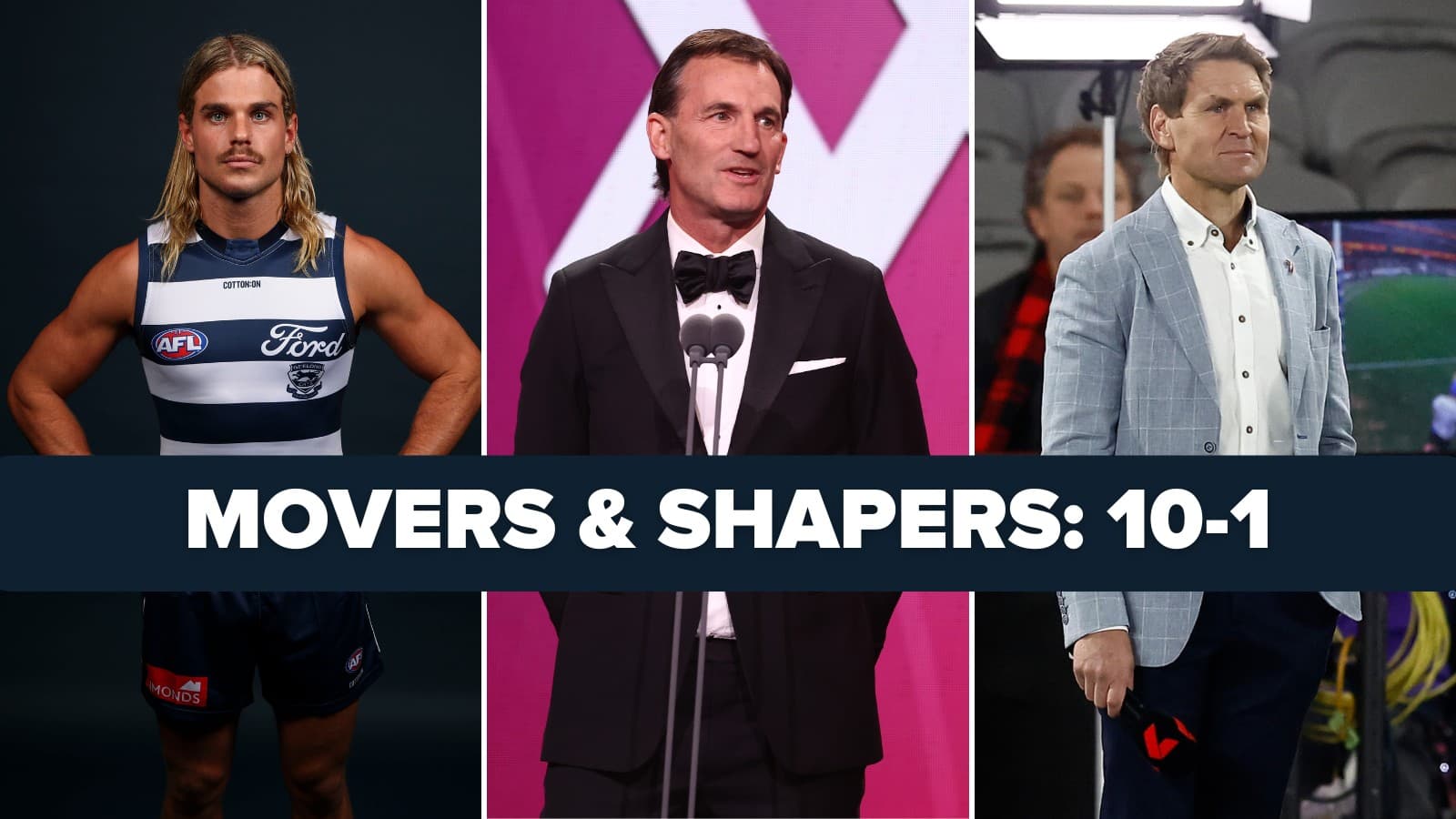
Moves have been made at AFL House, and they are reflected in the AFL Record’s annual Movers and Shapers list.
The natives were getting restless last year after a series of missteps out of AFL House that raised serious questions about the lack of direction and perhaps even the capabilities of those charged with running it.
Then came AFL CEO Andrew Dillon’s stunning raid on the game’s northern stronghold, appointing Sydney’s Tom Harley and Brisbane’s Greg Swann to key roles.
With a new chairman in the house and a beefed-up executive team, the League seems better placed to tackle some of the big issues ahead – player health and welfare, how the game is played, Tasmania and the rapidly changing media and fan landscape.
Here is this year's Movers and Shapers list.
50. SCOTT FITZGERALD
Marvel Stadium General Manager
Last year: -
The romantics would like to see the AFL’s own stadium kept vacant after the men’s season for a few AFLW finals. But there is not a hope in hell that the AFL will forfeit the chance to make millions as the likes of Oasis, Metallica and Lady Gaga swing through and sell out Marvel Stadium night after night. Under Fitzgerald’s watch, Marvel has now become one of the world’s premier concert venues, and Billboard recently named him in its 2025 Touring Powers List.
49. RHETT BARTLETT
Online footy historian
Last year: 44
Bartlett remains the poster boy for preserving footy’s visual history via his Rhettrospective YouTube Channel. Through dogged determination and countless hours invested, he has broken new ground over the last 12 months unearthing football moments thought forever lost, headlined by rescuing the entire second half of the Demons triumph over Collingwood in the 1964 Grand Final.
48. ZIPPORAH ‘ZIPPY’ FISH
Sydney AFLW Rising Star
Last year: -
Her debut season as an 18-year-old was the equal to any teen draftee in the League’s history. 21 disposals per game for an improving Swans team stamps her as a future superstar, and she was duly rewarded with the League’s Rising Star award. The combination of talent and, of course, that instantly unforgettable name, makes Fish the probable face of AFLW in Sydney for the next decade.
47. DANIEL GORRINGE
Podcaster, influencer
Last year: -
26 games for Gold Coast and Carlton doesn’t scream box office, but in this era of content, Gorringe is. Ask organisers of the Legends Game that revelled in him single-handedly selling out bays of Marvel Stadium. Continuing his Dan Does Footy podcast, Gorringe will also be on the AFL’s books in 2026. There’s even supposed bad blood between his ex-boss and fellow podder Dylan Buckley. Could we see an Oasis-Blur style feud between footy podcasters during 2026?
46. CAL TWOMEY
AFL Media journalist
Last year: 43
A decade of being the draft specialist at AFL.com.au is paying off in various ways for Twomey. As hunger for draft and trade stories intensifies, Twomey’s accurate predictions have become gospel. While the years of investment in developing relationships with draftees before they were famous give him the best phone list of player contacts in the business, making him a central media conduit on player movement. Breaking the Nasiah Wanganeen-Milera decision was evidence of that.
45. MATTHEW CHUN
AFL Executive General Manager, Finance, Clubs and Infrastructure
Last year: -
Having overseen the $225 million refurbishment of Marvel Stadium, he is now the League’s point man as it seeks partners for the redevelopment of AFL House and the neighbouring building that was formerly the home of Channel Seven, as well as the League’s move to its new Collins Street abode. All major building and infrastructure projects involving the League (Tasmania and its various stadia in particular) all come across his desk.
44. SAM MITCHELL
Hawthorn Coach
Last year: 18
Went 0-2 in his quest to lure more big names to Hawthorn - Harley Reid and Zach Merrett - but not through lack of trying. Continues to put his own stamp on the Hawks with both a flair for innovation and the rat cunning that marked his playing days, but it was consecutive knockout finals wins away against the GWS Giants and then Adelaide that underlined his coaching prowess.
43. MARCUS BONTEMPELLI
Western Bulldogs Captain
Last year: 45
Missed the first five games last year yet it was another season of brilliance from the Bont, the best player in footy over the last 10 years. Like Nick Daicos, a marketer’s dream and not surprisingly the first player named to play for Victoria in the revived state of origin format.
42. DANIEL HOYNE
Champion Data Analyst
Last year: -
As the public face and voice of Champion Data, Hoyne delivers one of footy’s must-listen weekly segments with his Full-on Footy Analysis on SEN Sportsday. Behind the scenes, Hoyne’s influence is greater. The trends he finds in the game not only shape the way the game is broadcast and analysed by the media, but it’s also the data coaches and players use to keep track of how the game is evolving.
41. DAMIEN HARDWICK
Gold Coast coach
Last year: -
Poised to create a winning legacy at Gold Coast with just as much impact as his glorious Tigers success. A team chock-full of talent has added an established premiership superstar in Christian Petracca to push further up the ladder. Add the rich vein of cheap topline academy prospects and there is no coaching position with as much chance of success over the next five years as Hardwick’s.
40. PAUL GUERRA
Melbourne chief executive
Last year: -
Consider what the new boss of the Demons had to deal with when he finally assumed the job last September. New coach. Exiting Christian Petracca and Clayton Oliver. Getting negotiations for the Caulfield racecourse move back on track. Guerra boasted a brilliant business CV when he joined the Dees but is rapidly learning that football is a different beast entirely.
39. CAROLINE WILSON
Broadcaster, journalist
Last year: 35
2026 will be the ninth season since Wilson stepped down from the chief football reporter role at The Age, supposedly then fading away into retirement. It’s been anything but. Her move to Seven last season reinvigorated her television presence, while her Saturday column remains mandatory reading. All these years on, nobody has a line on the machinations of AFL House and its clubs like Caro.
38. LAURA KANE
AFL Executive General Manager, Football Operations
Last year: 2
Her role at AFL HQ was effectively halved last year once Greg Swann came on board to oversee football performance, but Kane remains in charge of what is effectively the League’s raison d’être, the AFL and AFLW competitions, as well as a beefed-up health and medical team.
37. AMEET BAINS
Western Bulldogs chief executive
Last year: -
Narrowly beaten by Tom Harley to become COO of the AFL, he is now the third longest-serving club chief executive, but significantly the longest of any club in Victoria. The Dogs have grown enormously under his watch and his calm and measured approach to recontracting Luke Beveridge as coach was masterful and which other clubs should consider emulating.
36. TOM MORRIS
Seven/SEN journalist
Last year: 47
Expect Morris’ move from Nine to Seven to place him in Seven’s match broadcasts, assume news and hosting roles across multiple nights of its Agenda Setters program, and be the marauding chief newshound across all Seven’s footy and news offerings. With an expanded role at SEN and the freedom to chase the biggest stories without being chained to the daily grind of the newsroom, it has some echoes of Eddie McGuire’s seismic move to Nine in the 1990s.
35. STUART FOX
Melbourne Cricket Club chief executive
Last year: 31
As the chief of the game’s cathedral, Stuart Fox’s decisions shape the way Victorians, and visitors, experience the game at the MCG. His decisions in 2026 may be the most crucial of his career. With a state election looming and the clock ticking on the lifespan of the Warne Stand, if and what he can negotiate with the Victorian government for a rebuild will determine how we watch, and perhaps how many can watch big games, for a generation.
34. GRAHAM WRIGHT
Carlton chief executive. Last year: 23
Running the football departments successfully at the Hawks and Pies (where he was a premiership wingman) prepared him well for his new role at the Blues where it was the core product - footy - that needed his immediate attention. Made two big calls at the start, retaining Michael Voss as coach and trading disgruntled superstar forward Charlie Curnow. It’s a new era at the Baggers.
33. ANTHONY HUDSON
Commentator
Last year: 28
Remains the clear best TV football commentator in the business and he completed a sterling year of work as the voice of Friday night games as for the first time, Fox Footy produced its own broadcast of the showpiece game. Was also on the mic for the first FOX Grand Final telecast, albeit called from a TV studio.
32. SHARON McCROHAN
AFL Executive General Manager Corporate Affairs
Last year: -
The AFL hit a home run when looking to replace longtime corporate affairs boss Brian Walsh last year by luring McCrohan, a major force in government, business, sporting and media circles for many years. She’s still finding her way, but there isn’t much that will cross her desk at AFL House that she’s not seen nor dealt with before.
31. MICHAEL WARNER
Herald Sun journalist
Last year: -
You could just about fill the MCG with accredited members of the AFL media, but not many can set the hearts of footy’s bigwigs racing like Warner when his name appears on their iPhones. Old-school reporter who operates without fear or favour.
30. CHARLIE CURNOW
Sydney key forward
Last year: -
The Swans came home like a train last year, winning eight of their 11 games (including Brisbane at the Gabba), but it is the trade for Curnow, a dual Coleman Medal winner at Carlton, that pries their premiership window back open. In crossing to the Swans, he follows in the footsteps of Tony Lockett, Barry Hall and Lance Franklin in taking his considerable talents to the SCG.
29. DR KATE HALL
AFL Head of Mental Health and Wellbeing
Last year: -
Takes the lead for the AFL in all areas related to mental health across the industry, but especially the playing cohort. It is an incredibly complex and at times, fraught issue for the AFL. But when Andrew Dillon clears his schedule and drives down to Geelong for a chinwag with Bailey Smith around the firepit, that’s the sort of approach Hall helps shape.
28. ANDREW PRIDHAM
Sydney Swans chairman
Last year: -
Through a combination of length of tenure (12 years) and geography, he is one of the most influential AFL club leaders, although not enough to get his friend and business partner, former Collingwood president Jeff Browne over the line as the new AFL chairman. The Swans are a behemoth in Sydney but will always face hurdles in a market that will never obsess about the indigenous code.
27. SAM DARCY
Western Bulldogs key forward
Last year: -
Had the game in raptures after his brilliant start to the season, shocked and saddened when he appeared to suffer a serious knee injury in Round 6 and then breathed a collective sigh of relief when scans showed he had avoided an ACL. The upside is enormous and he figures to become not just the best key forward but the best player in the competition in the next 12 months. Ruthlessly competitive.
26. JASMINE GARNER
North Melbourne captain
Last year: -
Daisy Pearce and Erin Phillips are the iconic figures of AFLW’s early years, yet after the competition’s 10th season it’s Jas Garner who stands as its most decorated player. Year-after-year, it is Garner’s excellence that drives North Melbourne’s excellence. Elevated to skipper in 2025, she overcame an injury scare to lead an unbeaten season of perfection.
25. LACHIE NEALE
Brisbane midfielder
Last year: 20
Two-time Brownlow Medallist and now two-time premiership player and skipper, Neale was the story of the 2025 Grand Final with his unlikely injury recovery, and substitute role that powered the Lions away. Within months, the crowning moment of his career was overshadowed by the post-season marital scandal that has clouded his future. The real prospect of Neale’s Lions career being over for a move back to Perth at season end will be one of the dominant storylines of 2026.
24. JOSH BOWLER
AFL Head of Strategy and Scheduling
Last year: 40
Every November and at various other stages during the year, all eyes turn to Bowler, as the gatekeeper to arguably the League’s most powerful equalisation measure – the fixture. Few schedules in world sport are more complicated than the AFL’s for a multitude of factors and while the powerful software helps considerably, Bowler desperately rides the fortunes of the teams he has banked on for the bright lights of Thursday and Friday night footy.
23. JEREMY ROCKLIFF
Tasmanian Premier
Last year: -
Tasmania has not seen a bigger political issue since the Franklin Dam in the 1980s, yet now the state’s new stadium and its new team are assured the headaches for Rockliff will not subside. The AFL and Rockliff’s fragilely held government will need to work in watertight harmony to navigate the next three years. Apart from the builders, expect Rockliff’s office to be the most dialled number from Docklands for the next three years.
22. MICHAEL WILLSON
AFL Media Photographer Last year: - With an innate feel for the game and especially what might be about to happen, Willson is arguably football’s greatest storyteller. And it is not just his in-game work that raises the bar. Shots such as those taken at Troy Selwood’s funeral last year, underline his greatness behind the lens.
21. JACINTA ALLAN
Victorian Premier
Last year: -
A new Liberal leader in Victoria has the state poised for its most competitive election in more than a decade at the end of 2026. Labor’s Allan will be looking for big-ticket items to take to that election, and there isn’t a bigger ticket for Victorians than their beloved MCG. 2026 looms as the time the long-mooted plans for redevelopment of the Warne Stand are committed to as an election promise, with Allan the ultimate decision-maker on what and when.
20. JAMES GALLAGHER
AFLPA Chief Executive
Last year: -
Filled the massive shoes left by Paul Marsh, who returned to cricket last October. The former GM of legal at the PA who was most recently the strategy boss at North Melbourne, he has made a low-key start to a key footy industry role, but the meaty issues will soon arise.
19. ROSS LYON
St Kilda coach
Last year: 36
Ever since the departure of CEO Simon Lethlean in 2023, this hasn’t just been Ross’ team, it’s been Ross’ club. Nobody is in any doubt that Lyon is getting exactly what he wants, like players. The recruiting splurge, kicked off with the recommitment of emerging superstar Nasiah Wanganeen-Milera, has led to excitement at Moorabbin not seen since Lyon led them into Grand Finals. It will also mean expectations. Yet if there’s one coach whose experience and force of personality, will stare that down with ease it is Lyon.
18. PETER MALINAUSKAS
South Australian Premier
Last year: 32
If Gather Round is football’s biggest party, Malinauskas is its Van Wilder - the party liaison of the Adelaide football celebration. For Malinauskas, who single-handedly campaigned for and dreamed even bigger than the AFL imagined at conception, it has earned him universal national respect and plaudits beyond what any other state leader could imagine. And while day-to-day political issues will always smudge the sheen at home, securing a new agreement for Gather Round in the last year of the current deal will preserve his overwhelming approval rating.
17. CHRIS FAGAN
Brisbane Lions coach
Last year: -
A second premiership coupled with a loveable grandfatherly nature means Fagan has gone beyond AFL success to verging on national treasure status. With the talent the Lions possess there is no reason why Fagan cannot add more premierships to the cabinet, while giving newfound respect for all those over 60 in the Australian workforce.
16. ANDREW WELSH
Essendon president
Last year: -
The former player and successful property developer replaced David Barham last September and within hours declared that wantaway skipper Zach Merrett would not be traded to Hawthorn and traded he was not. It was a ‘line in the sand’ moment for the Bombers, dare we say it, and perhaps a turning point for a club seeking to shed 20 years of mediocrity.
15. PAUL CONNORS
Player manager
Last year: 5
The change of name from Connors Sport to CDG Sports reflects the realignment of the business and the huge influence in the player space of business partners Robbie D’Orazio (Bailey Smith, Charlie Curnow and Nick Daicos head his client list) and Nick Gieschen, the manager of choice for many coming out of the pathway system. The latter pair are powerful, but it is Connors, as the figurehead, who drives the business and has the ear of everyone in the game.
14. CHRIS SCOTT
Geelong coach
Last year: 38
On the eve of last year’s Grand Final, Caroline Wilson reported on the weeks-long despair Scott felt after being eliminated from the 2024 premiership race. How Scott comes back from the greater disappointment of a Grand Final day that so swiftly fell apart for the Cats after half-time will be fascinating. Over the last 15 years, Scott has continually punched back harder after disappointment. The Cats’ young talent would suggest he has a plan this time too. Stand-out choice to coach Victoria this month, reflecting his standing in the game.
13. ZAK BUTTERS
Port Adelaide midfielder
Last year: -
The champion midfielder heads into this season sitting clearly atop the free agency class. Port’s fortunes from 2027 and beyond will be heavily impacted by his decision. The Dogs, Cats and Hawks are at the front of the queue if he returns to Victoria and their respective flag ambitions would only be further enhanced with his signature. His contract story will likely trump all others this year.
12. NICK DAICOS
Collingwood utility
Last year: 12
When fit and firing - which is most of the time - the younger Daicos is the best player in the AFL. A true utility, he is a genuine matchwinner, but he might need to be on a regular basis for a team whose premiership window is closing shut. Equally comfortable with the off-field demands that come with AFL stardom, Daicos without doubt would sit atop the Tassie Devils’ shopping list, and the Gary Ablett Jnr precedent in 2011 sits uneasily in the mind of every Collingwood supporter.
11. GERARD WHATELEY
Broadcaster, TV host, commentator
Last year: 19
That Gerard Whateley did not call marquee AFL matches on television before 2025 will one day be looked back upon as a confounding quirk of history. Now that he is, it completes the week-long cycle of Whateley being the broadcaster that holds our hands through the rhythms of the footy week. Setting the morning agenda on his daily SEN Radio show and the evening agenda on Fox’s AFL 360, his television and radio broadcasts are supplemented by the essential Crunch Time radio program. Whether it relates to on-the-field or off-the-field matters, his considered opinion is the one most listened to by the AFL and its clubs.
10. BAILEY SMITH
Geelong midfielder
Last year: -
On the field in 2025, Smith went from talent in waiting to All-Australian midfielder. Off the field he went from Insta-influencer to the AFL’s No. 1 heel villain. Whatever Smith does will attract attention again in 2026, and while it doesn't seem to affect his own form, how it affects a club that likes to see itself as humble and stable is another question.
9. KANE CORNES
Pundit
Last year: 11
The ‘Kane Train’ looks set to continue at high speed in 2026. His move to Seven to be their flagship expert comments broadcaster was a success, as was his central role in the new Agenda Setters program.
His ‘change room ban’ from North Melbourne and verbal stoush with Bulldogs coach Luke Beveridge only caused welcome hype for the host broadcaster.
On the radio front, the cult following of Ballers’, who “get up early” and “do the work” for his Monday and Friday SEN Breakfast program with David King continues to grow, and this year a shift from SportsDay to a new daily 5pm solo show will give him a new platform.
There is no grey area in the love or hate Cornes inspires. And unlike most in the football media, he appears completely comfortable with that equation.
8. CRAIG HUTCHISON
CEO, Sports Entertainment Network, TV host, podcaster
Last year: 14
40 years ago, Prime Minister Paul Keating explained Australia’s new media ownership laws by saying that a proprietor could be “Queen of the screen, or Prince of print, but not both.”
In the AFL world, Hutchison makes a mockery of that proclamation with his SEN group. It rules sports radio airwaves across the country with its signature product, which includes AFL Nation, publishes the AFL Record, and via his rapidly expanding Rainmaker division, creates more than 300 hours of football television each year for Seven. SEN takes in a diverse range of sports, but footy remains its beating heart. And when it comes to footy media, ‘Hutchy’ is the closest thing to a kingmaker. After engineering Caroline Wilson and Kane Cornes’ moves to Seven for 2025, this year Tom Morris’ move to Seven interconnected with an increased role on SEN underlines the benefits of his triple threat approach.
7. SHAY SEGEV
CEO, DAZN
Last year: -
The enormous elephant in the room for AFL bosses is how interested new Foxtel owners, London-based international streamer DAZN, will be in Australia’s domestic code and what size broadcast rights figure is feasible in a rapidly changing environment. If they cannot sell the virtues of the AFL to Segev, who presumably has little to no knowledge of the game, nor attract competitive tension from other global streamers over the next few years, the League has a major headache as it tries to stitch up the next rights deal (the current one expires in 2031).
6. CHRIS JONES
Channel Seven head of sport
Last year: 7
Jones’ ascension in 2024 led to the big fish singings of Kane Cornes and Caroline Wilson and multiplying its footy content. The concurrent global uncertainty around sports rights in the streaming era means a trusted free-to-air partner that is doubling down on footy is more important to the AFL than ever. Jones has spent his whole working life around footy media and knows how to use his growing influence to ensure Seven gets maximum value on investment. A later Grand Final and more Sunday night fixtures are his recent public pushes that head office will have heard.
5. TOM HARLEY
AFL Chief Operating Officer
Last year: -
The football lifer who excelled at everything - playing, broadcasting and administration - was coaxed out of the Swans, where he was chief executive, to manage a raft of major portfolios at AFL House. His main brief is the clubs, who have welcomed having one of their own in such a key role. Integrity and security, issues that every major sporting competition in the world is dealing with, also fall under his remit. His is a significant appointment, given that three most recent AFL bosses - Andrew Dillon, Gillon McLachlan and Andrew Demetriou - were sitting in the next office, biding their time until the big job came along. Harley is on the same track.
4. BRENDON GALE
Tasmania Chief Executive
Last year: 9
The Devils have been quietly building their football club, filling many important positions, but always with one unanswered question - what if they don’t get the stadium off the ground? That box has been ticked. The Tasmanian parliament finally legislated the Macquarie Point Stadium into being last December and Gale can get to work on many of his key appointments, especially head of football and the senior coach. But with the certainty of the team come the most critical conversations of all - with player managers as the Devils look to build the playing list that will take the field in 2028 ahead of their debut season. What sort of team does Tassie want to assemble? Gale won’t be the coach, nor the list manager. But with the runs on the board at Richmond, he will have a fair say on who will wear the inaugural jumper.
3. CRAIG DRUMMOND
Incoming AFL Commission Chairman
Last year: -
A 13-year Geelong director who served as president between 2021 and 2024, Drummond was formerly the chief executive of Medibank and held positions with National Australia Bank, Bank of America Merrill Lynch, and Goldman Sachs, and is currently chairman of Transurban Group. Elected to the AFL Commission late last year, he will formally assume the role as chairman last month, and while he won’t be trading media barbs with Peter V’Landys, his brash counterpart at the NRL, he will bring a sense of calm and accountability to the position as well as a huge reputation in business and football circles. He played the political game well, outmanoeuvring more high-profile candidates, Jeff Browne and Peter Gordon. Drummond is seen as genial and consultative, while holding true to what he believes is best for the game, and the wider football community will be keen to get to know him better in the coming months.
2. GREG SWANN
AFL Executive General Manager of Football Performance
Last year: 16
The haste with which Dillon moved to extract Swann from Brisbane, having turned an AFL basket case into a powerhouse, spoke volumes of the various football-related issues that were plaguing the League. While whip-smart, too much too soon was thrown at the relatively inexperienced Laura Kane, the erstwhile boss of all things footy at the AFL, so Swann, with 25 years of experience at running footy clubs was able to work through the major priorities and make immediate changes to aspects of the game such as the centre bounce (gone), the ruck rules (the craft of rucking is back), refinements to the stand rule and the formal introduction of last touch on the full as mechanisms, among others, to speed up the game. The speed with which Swann implemented these changes speaks to the power and influence he now yields and his commonsense approach was universally lauded by key stakeholders, most notably the clubs.
1. ANDREW DILLON
AFL Chief Executive Officer
Last year: 1
For years, the AFL’s headline numbers—attendance, television ratings, and participation—painted a picture of prosperity. Yet beneath the surface, the league’s core product, the elite 18-team men’s competition, was adrift. Concerns over rules, the judiciary, and the fixture were eroding confidence, and the game risked losing its edge. After an extended period of caution during his first 18 months as chief executive—and some warranted criticism early last year—Andrew Dillon moved decisively. He recruited two of the game’s most respected administrators: Sydney’s Tom Harley as chief operating officer and Brisbane’s Greg Swann to lead football performance. These appointments signalled a new era of bold reform. The changes came quickly. State of Origin football returned to the calendar. A five-week, 10-team finals series was unveiled. A suite of rule adjustments aimed at restoring balance and clarity was introduced. And Dillon’s firm stance on Tasmania paid off, with lawmakers clearing the way for a new Hobart stadium and the entry of the Devils into the AFL in 2028.
AFL
9 hours ago
AFL
10 hours ago
AFL
10 hours ago
AFL
11 hours ago
AFL
12 hours ago
AFL
13 hours ago
AFL
14 hours ago
AFL
14 hours ago